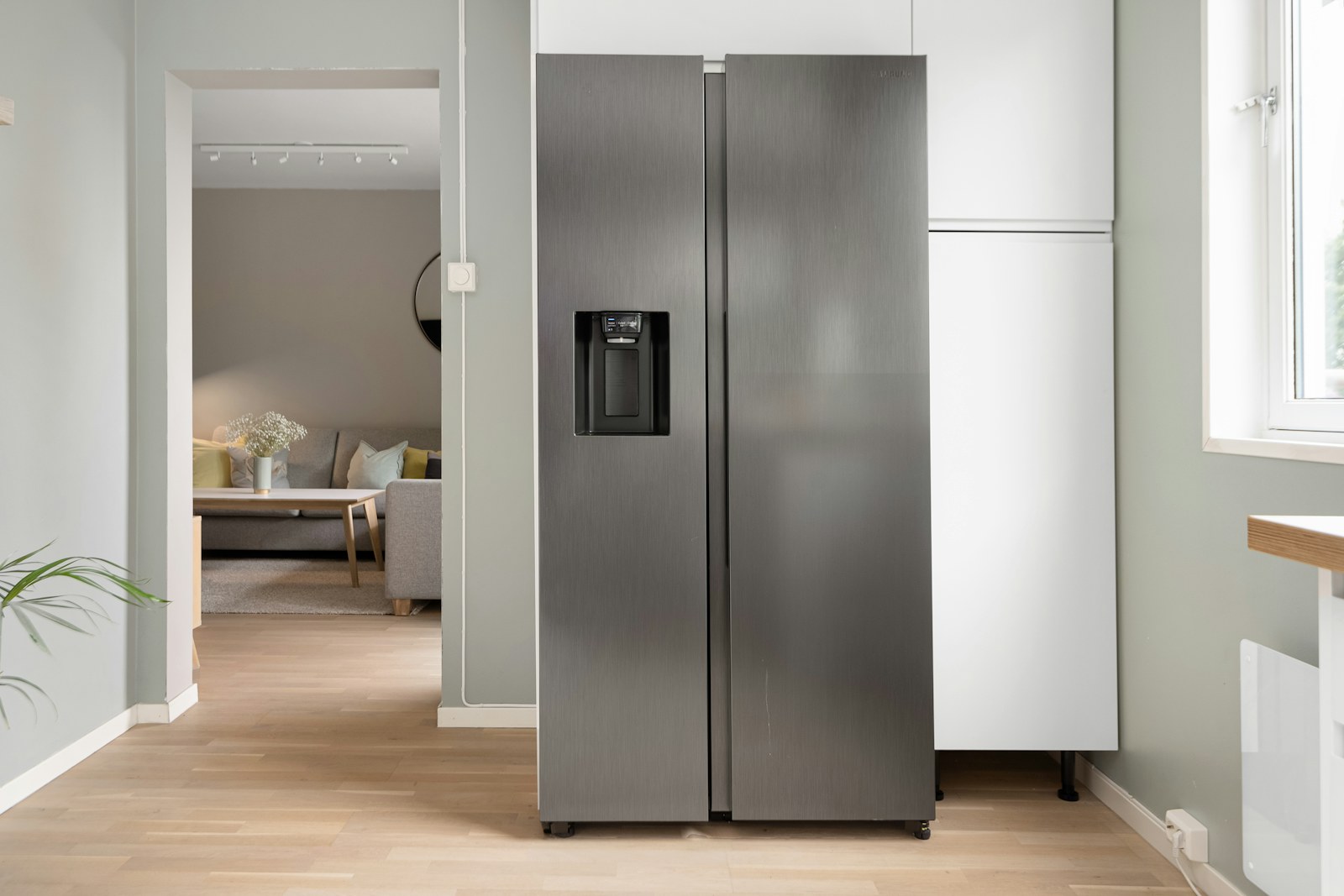
Why Samsung ice makers freeze the bucket into one solid block
Samsung French-door refrigerators put the ice maker in the refrigerator door, inside a small sealed ice room. Water reaches that room through a fill tube fed by the inlet valve behind the unit, and the ice maker carries its own small heater to keep the mold from freezing solid to the tray. When any part of that chain fails, water keeps arriving and cannot leave, so the bucket slowly becomes one solid block.
In practice it comes down to three causes. A water inlet valve that seeps a slow trickle when it is supposed to be fully closed. A fill tube that has iced shut so water backs up and refreezes around the mouth of the tube. Or an ice room running cold enough that incoming water freezes before it can settle into the mold and form a proper cube. Each one needs a different fix, and the visible evidence points to which.
The water inlet valve and a frozen fill tube
The inlet valve is a solenoid that opens for a few seconds per cycle. Debris in the water, low household pressure, or a worn valve seat lets water leak past even when the valve should be shut. That slow drip lands in the fill tube, freezes, and builds until the tube is blocked and the ice maker overflows into the bucket. Frost or a solid plug at the fill tube is the evidence you are looking for.
Checking the valve is straightforward with a meter. Measure the coil for the expected resistance, confirm the valve seats and closes fully under line pressure, and confirm the fill tube is clear and pushed fully into the ice maker. A clogged household water filter or a saddle valve set too far into the pipe can also starve the ice maker, so it fills halfway and produces hollow or undersized cubes instead of nothing at all.
The ice maker assembly and its harvest cycle
Samsung's ice maker is a modular assembly containing the mold, the ejector arm and motor, a thermistor, a small heater, and the control that runs the harvest cycle. The thermistor tells the unit when the water has frozen into cubes and when to start harvesting. A failed thermistor, a jammed ejector, or a burned-out heater leaves the tray full while the cycle repeats or stops altogether.
Many of these assemblies have a test button that starts a harvest cycle on demand. Pressing it separates the possibilities quickly: if the motor, the heater, and the ejector all run and drop cubes, the fault is upstream in the water supply or the temperature control. If nothing moves, the assembly itself is the problem. That single test tells a technician more than an hour of watching the unit cycle on its own.
Temperature settings and the ice room
An ice maker needs the freezer at 0 degrees Fahrenheit to form solid cubes. Set the freezer to 5 or 10 degrees and the tray never freezes fast enough, the harvest cycle stalls, and cubes come out cloudy, wet, or stuck together in the bucket. Returning the freezer to 0 and the refrigerator section to about 37 degrees resolves a real number of ice complaints on its own, before any part is replaced.
Too cold causes its own problem. When the ice room drops well below freezing and the ice maker's small heater is weak or failing, incoming water freezes to the mold and to the fill tube before it can form a proper cube. If the unit was recently moved, defrosted, or unplugged, cycle the power, give it eight hours to stabilize, and see what the ice room does before you assume a part has failed.
Diagnostic reset and reading what the unit reports
Samsung refrigerators track ice maker faults in the control's memory, and many models expose a self-diagnostic mode from the front panel that reports a stored code. That code separates a sensor fault from a water supply fault and saves a great deal of guessing. A full power reset, five minutes with the unit unplugged, clears false faults and stops a cycle that is stuck mid-harvest.
Before you reset, write down the symptom in detail: no ice at all, hollow cubes, wet cubes, a bucket that overflows, or a solid frozen block. Each one points somewhere different. No ice implicates the valve or the assembly, hollow cubes point to low water flow, and a frozen block points to a seeping valve or an iced fill tube. Notes like that keep a technician from starting the diagnosis from zero on the visit.
What the repair involves and what it costs
Replacing an ice maker assembly, replacing a water inlet valve, and clearing and reseating a fill tube are each handled in a single visit in most cases. A clogged water filter or a shut-off valve that was never fully opened is not a repair at all, and that is worth confirming before any parts are ordered. The diagnostic is $95 and it is credited in full toward the repair when you approve it.
Most completed repairs on this symptom land between $145 and $295 depending on the part required, and every completed repair we do carries a 90-day warranty. If the ice room has been frozen solid for weeks, expect a thaw and a full defrost to be part of the job, because a block of ice that size will not clear on its own once the underlying cause is fixed.
← All guides